
This is a lengthy read, not meant for skimming, but for being a thorough source of everything related to navigate T4 and T5 filing with the Canada Revenue Agency (CRA).
Apologies in advance for being long-winded.
As a business owner in Canada, handling payroll and investment income reporting can be daunting. T4 slips report employee earnings and deductions, while T5 slips cover investment payouts like dividends. Filing these correctly prevents audits, fines, and stress. This guide explains what they are, who must file, deadlines, steps, and tips, drawn from official CRA sources and expert insights. The aim? Help you stay compliant so you can focus on your business growth.
Whether you're running a small corporation in London, Ontario, operating in the Forest City, or managing a growing business anywhere across Ontario, understanding your T4 and T5 obligations is essential for staying compliant with CRA requirements.
What is a T4 Slip?
A T4 slip, or Statement of Remuneration Paid, is a form employers use to report an employee's annual income, commissions, taxable benefits, and deductions like Canada Pension Plan (CPP), Employment Insurance (EI), and income tax. It's essential for employees to file their personal taxes and for the CRA to verify withholdings.
For example, if you paid an employee salary, bonuses, or benefits like group insurance, these go on the T4. It includes boxes for specifics: Box 14 for total employment income, Box 16 for CPP contributions, and so on. If no deductions were made but payments exceeded $500, a T4 is still required. Special cases, like self-employed fishers or taxi drivers, use codes like 78-83 for income reporting.
What is a T5 Slip?
The T5 slip, or Statement of Investment Income, reports payments like interest, dividends (eligible or non-eligible), royalties, or foreign income paid to Canadian residents. Businesses, banks, or corporations issue it if payments total over $50 in a year.
For instance, if your company pays dividends to shareholders or interest on loans, prepare a T5. Key boxes include Box 10 for dividends other than eligible, Box 24 for actual dividends paid, and Box 15 for interest. Joint accounts need only one slip, but nominees or agents for non-residents may have additional rules.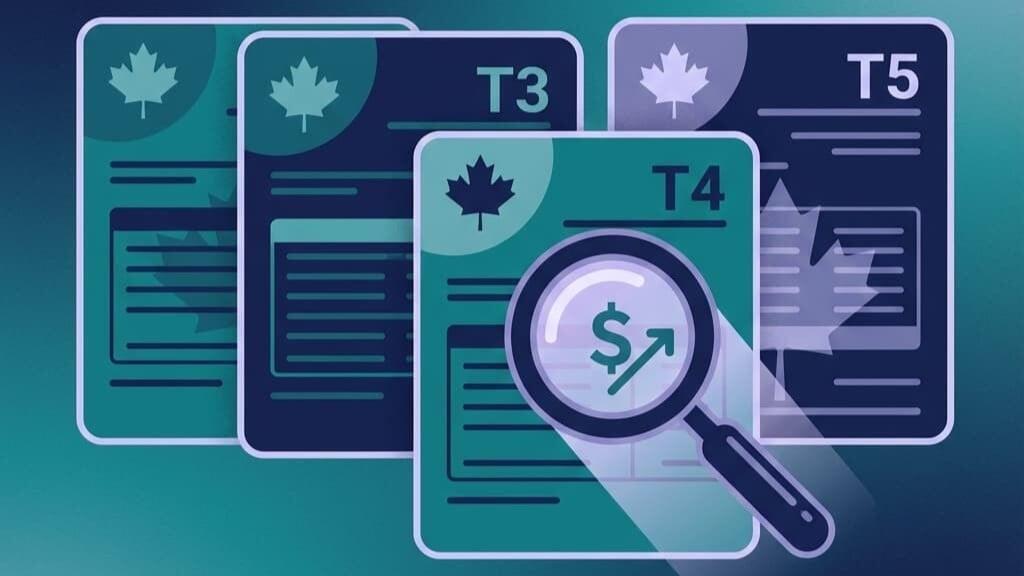
Why Businesses Need to File T4 and T5 Slips
Filing ensures the CRA can cross-check income reported by recipients. For T4s, it confirms proper payroll deductions, reducing underpayment risks. Non-filing can lead to penalties starting at $100 per slip, up to $7,500 for intentional failures.
T5s help track investment income, which is taxable. Late or incorrect filing triggers similar fines, plus interest on unpaid taxes. Compliance builds trust with the CRA and avoids audits, especially for small businesses in high-scrutiny sectors like finance or real estate. Plus, accurate slips aid employees and investors in claiming credits, like the dividend tax credit.Who Must File?
T4: Any employer (resident or non-resident) paying remuneration, if deductions were made or total pay >$500. This includes sole proprietors, corporations, and trusts with employees.
T5: Payers of investment income >$50, such as corporations distributing dividends, banks paying interest, or businesses with royalty agreements. Nominees receiving payments for others must file too.

Filing Deadlines and Penalties
Both T4 and T5 must be filed by the last day of February following the calendar year (e.g., February 28, 2027, for 2026 income). If it falls on a weekend, the next business day applies. Distribute copies to recipients by the same date.
Late filing penalties:
$25 per day for T4/T5, minimum $100, maximum $7,500.
Electronic filing is mandatory for >50 T4 slips or >5 T5 slips (updated threshold for recent years). Paper is allowed for fewer.
How to Prepare and File T4 Slips
Gather Data: Collect employee info, SIN, address, income, deductions. Use payroll software like QuickBooks for accuracy.
Fill the Slip: Download fillable T4 from CRA. Enter employer BN (15-character account number), year, and box details. Don't include non-taxable items like certain reimbursements.
Complete Summary: Submit a T4 Summary totaling all slips, reporting total deductions remitted.
File: Use CRA's Web Forms (up to 100 slips free), Internet file transfer (XML), or mail paper forms to Ottawa Tax Centre.
Distribute: Send two copies to employees (paper or electronic with consent), keep one for records (six years).

How to Prepare and File T5 Slips
Collect Info: Recipient name, SIN/BN, payment types (e.g., dividends). Threshold is $50 total per recipient.
Fill the Slip: Use CRA's fillable T5. For joint owners, list primary on first line. Report actual amounts paid, not accrued.
Summary: File a T5 Summary aggregating all slips.
File: Electronic via Web Forms or XML if >5 slips; paper otherwise. Send to Winnipeg Tax Centre.
Distribute: Provide copies to recipients by deadline.
Common Mistakes to Avoid
Underreporting: Missing bonuses (T4) or small interest payments (T5).
Incorrect Boxes: Mixing eligible/non-eligible dividends or forgetting CPP exemptions.
Late Distribution: Recipients need slips for their taxes, delays cause complaints.
Misclassification: Treating contractors as employees (file T4A instead).
No Electronic Filing: Ignoring thresholds leads to rejection.

Special Tips for Business Owners
Sole proprietors: Report T4 on personal returns if employing others. For T5, track shareholder dividends carefully. Use CRA's My Business Account for online filing and status checks. If in investments, join associations for updates. Voluntary disclosure fixes past errors without penalties. Start with free CRA tools; scale to software as you grow.
Conclusion
Mastering T4 & T5 filing empowers Canadian business owners to comply effortlessly, saving time and money. By preparing early, using digital tools, and double-checking, you'll minimize risks. Act now, review your 2025 records today for seamless 2026 filing.
Sources:
T5 slip
If you're a business owner in London, Ontario (the Forest City) or anywhere across Ontario and need professional guidance with T4 or T5 filing, working with an experienced CPA can help you avoid penalties and file with confidence.