
Behind on taxes in Canada? Start by identifying every overdue return, rebuilding reliable records and filing accurately. If you cannot pay in full, discuss a realistic payment arrangement with the Canada Revenue Agency (CRA). Interest generally continues on unpaid balances; relief is a separate request, not an automatic benefit of a payment plan.
A shoebox of receipts is excellent at holding receipts. Unfortunately, it has never once filed a tax return. If your paperwork has become an unofficial office pet, this guide gives you a practical way forward.
For owners in London, Ontario, the first question is which taxpayer and account are behind: you personally, your corporation, GST/HST, payroll, or several at once. Their deadlines and consequences differ. This guide focuses on corporate catch-up work while highlighting those boundaries.
Updated October 20, 2026. The story below is fictional and educational, not a client testimonial or a promise of results. Images are illustrative.

Why filing late and paying late are different problems
Filing tells the CRA what the business earned and owes. Payment settles that obligation. Waiting until you can afford the entire balance can leave both problems unresolved. However, rushing out invented numbers creates another problem. The aim is prompt, supported filing, with a separate plan for the money.
Most Canadian-resident corporations must file a T2 every tax year, including inactive corporations and those with no tax payable, subject to limited exceptions. A quiet business year does not automatically mean a quiet filing calendar. CRA T2 filing requirements.
What can overdue corporate taxes cost?
Late-filing penalties
The standard corporate late-filing penalty is 5% of unpaid tax due at the filing deadline, plus 1% for each complete late month, up to 12 months. A higher penalty can apply when the CRA issued a demand to file and assessed a failure-to-file penalty in one of the previous three tax years: 10%, plus 2% per complete month, up to 20 months.
For illustration, assume $20,000 remains unpaid at the filing deadline and the return is six complete months late. The standard calculation is $20,000 × 11% = $2,200. If the higher penalty conditions apply, it is $20,000 × 22% = $4,400. These simplified examples exclude interest and other possible charges. A previous late return alone does not establish the higher penalty. CRA corporate penalties.
Interest on unpaid balances
Corporate arrears interest compounds daily from the balance-due day until payment. Rates can change, so use the applicable CRA rate for each period rather than assuming one percentage applies throughout. Filing or agreeing to instalments does not erase accumulated charges or freeze interest. The longer a balance remains unpaid, the more important an affordable repayment strategy becomes. CRA guidance on corporate interest.
A fictional five-step tax catch-up story
Meet Maya, the fictional owner of Forest City Repairs Inc. in London. A busy season, a family illness and an unfinished bookkeeping handover left her unsure which filings were missing. She has customers to serve and limited cash. Her goal is a workable recovery plan, rather than a miraculous overnight fix.
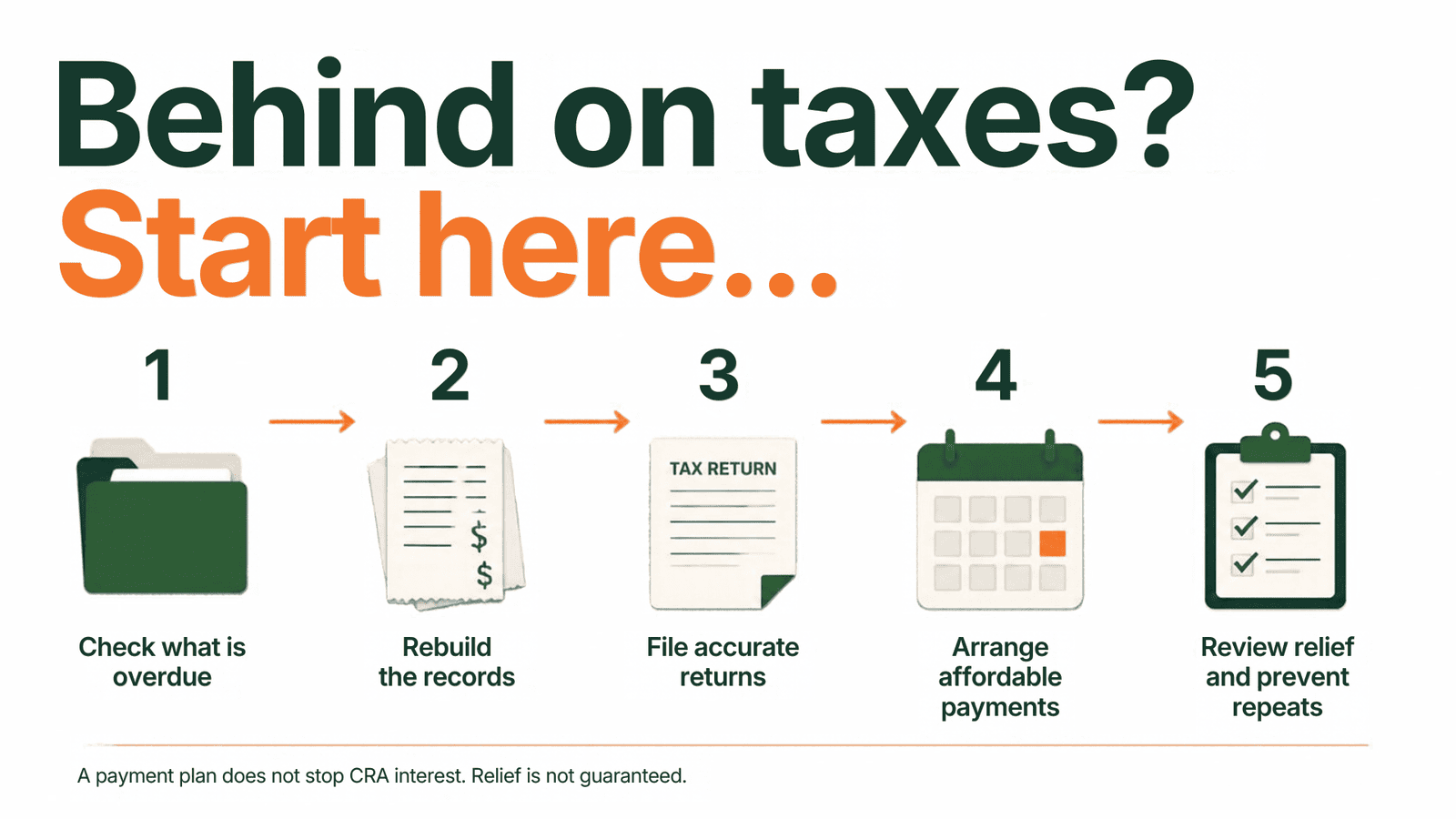
Step 1: Identify every missing return and deadline
Maya gathers CRA notices and checks her business accounts with her accountant. Together they list the corporation's fiscal year-end, T2 returns, GST/HST periods, payroll obligations, amounts assessed and unanswered letters. They separate confirmed balances from estimates and flag any response deadlines.
A T2 is generally due six months after the corporate tax year-end. The corporate income tax balance is generally due two months after year-end, or three months where the relevant conditions are met. Instalments may also apply. That means payment can be overdue before the return is due. Personal and self-employed returns follow different rules. CRA T2 deadlines.
Maya's next move: one dated checklist, with an owner assigned to each task. The mystery pile finally becomes a defined project.
Step 2: Rebuild records before guessing numbers
Maya downloads bank and credit-card statements, sales invoices, payment-processor reports and loan statements. She gathers receipts, payroll reports and the previous accountant's working papers. Her accountant reconciles transactions, identifies missing support and separates personal spending from business activity.
A bank deposit is not always revenue; it might be a loan, shareholder contribution or transfer. Likewise, a card payment does not automatically establish a deductible business expense or an input tax credit. Unexplained differences go onto a questions list rather than disappearing into a convenient expense account.
Maya's next move: answer ten specific questions each afternoon instead of trying to solve two years in one anxious evening. She keeps a record of missing documents and how each issue was resolved.

Step 3: File the outstanding returns accurately
Once the records support the figures, Maya and her accountant prepare the missing filings and check opening balances and carryforwards between years. They confirm submission acceptance, retain copies and review subsequent notices against the filed returns. Sending a document is not the same as checking that it was accepted.
They also discuss whether a voluntary disclosure should be assessed before taking filing action. The CRA's Voluntary Disclosures Program has eligibility and completeness requirements; it is not automatic amnesty for every late return. Where relevant, get advice on the sequence before submitting information. CRA Voluntary Disclosures Program.
Maya's next move: track each return through preparation, submission and assessment, keeping current filings moving while older work is completed.
Step 4: Agree on a payment plan the business can maintain
The company cannot clear everything immediately. Maya prepares a cash-flow forecast showing collections, wages, essential expenses and current taxes. She contacts the CRA about repayment using realistic figures, rather than promising an amount that would make the next payroll impossible.
The CRA allows eligible debts to be paid over time. If a collections officer has written, contact that officer promptly. Keep agreed payments and future filings current; call before a payment becomes unaffordable. A payment arrangement is not blanket protection from every collection measure, and other credits may still be applied to the debt. CRA payment arrangements.
Maya's next move: a calendar reminder before each payment and a separate reserve for new obligations. Interest on the unpaid balance still needs budgeting.

Step 5: Review relief options and prevent a repeat
Maya documents the illness, the affected dates and its connection to missed obligations. Her accountant considers whether a taxpayer relief request is appropriate. Relief may address penalties and interest in qualifying circumstances; it does not cancel the underlying assessed tax. Time limits and supporting evidence matter, and approval is not guaranteed. CRA taxpayer relief eligibility.
She also appoints a backup for bookkeeping, schedules monthly reconciliations and checks the next filing dates quarterly. The fictional outcome is deliberately modest: she understands the outstanding work, knows who is doing it and can monitor payments. There is no invented refund, guaranteed penalty cancellation or instant interest holiday.
What should you bring to a catch-up appointment?
Bring CRA correspondence, your business number, fiscal year-end, last filed returns, financial statements and access to accounting records. Add bank statements, sales and expense records, payroll summaries, loan information and a list of missing documents. Explain any urgent collection notice at the start. Share sensitive documents through a secure process, rather than posting account details in a public comment.
Before the meeting, write down what has already been submitted, who prepared it and which confirmations you have. If you changed accountants or software, explain when that happened and where the earlier files are stored. A short timeline can be more useful than a long apology. Nobody needs an award-winning explanation for a missing receipt; they need enough information to decide what evidence to obtain next.
For Maya, the most helpful change is a weekly fifteen-minute review. She checks unresolved questions, upcoming dates, payments made and the remaining balance. When a customer pays late, she updates the forecast immediately rather than assuming the original plan still works. Her accountant can then focus on the issues requiring judgment. This routine is a practical example, not a prescribed CRA process: choose a review schedule that fits your business and the urgency of your outstanding obligations.
Frequently asked questions about late taxes in Canada
Can I file if I cannot afford the tax?
Yes. Filing and payment are separate. Prepare an accurate return promptly and discuss repayment. Paying what you can reduces the unpaid balance, but does not remove the need to file.
Does a CRA payment plan stop interest?
No. Interest generally continues on outstanding amounts. Keep repayments, new obligations and any relief request separate in your planning.
Does an inactive corporation still need a T2?
Generally, yes. Most resident corporations file annually even without income or tax payable. Confirm the limited exceptions and any separate GST/HST or payroll requirements.
Is the T2 deadline also the payment deadline?
No. The six-month filing window is different from the generally two- or qualifying three-month balance-due period. Check instalments separately.
Can penalties or interest be cancelled?
Sometimes, through an applicable relief process. Eligibility, evidence and timing govern the decision; needing help does not guarantee approval.
Get help catching up in London, Ontario
Bhundhoo Tax can help review outstanding corporate filings, reconstruct bookkeeping and organize the next steps. Book a conversation with a CPA and identify the years, accounts and notices involved. Start with clarity, then work through the backlog in a sensible order.
General educational information, checked against the CRA sources linked above on October 20, 2026. Your deadlines, penalties and relief options depend on your circumstances.