
Most business owners don't realize how much of their week disappears into tasks that have nothing to do with actually growing their business. Answering the same customer questions. Re-entering the same data. Chasing invoices. Scheduling and rescheduling. None of it requires creativity, judgment, or vision, yet it eats the hours that could go toward those very things.
This is where the fear around AI in business gets it backwards. The conversation is often framed as "AI vs. entrepreneurs," as if machines are coming to replace the people running the show. In reality, the data tells a very different story: AI isn't replacing business owners, it's replacing the repetitive work that was never a good use of their time in the first place.
If you're trying to figure out where AI fits into your business without losing the human judgment that makes it yours, this article breaks down exactly that.
The Myth of AI Replacing Entrepreneurship
Entrepreneurship isn't a task, it's a series of decisions. Deciding what to build, who to hire, which risks are worth taking, and how to treat customers. AI cannot replicate ownership, vision, or accountability. What it can do is take over the mechanical, repeatable parts of running a business that were quietly draining energy from those bigger decisions.
Recent industry data backs this up. A 2026 report found that 89% of small businesses are now using AI, and the majority are applying it specifically to automating repetitive tasks and improving efficiency. This isn't about cutting people out of the business, it's about cutting out the parts of the job that never needed a human in the first place.

Where AI Is Actually Being Used
Small business owners aren't handing over strategy to AI. They're handing over the tasks that were always closer to admin work than leadership:
- Scheduling and appointment booking
- Invoicing and payment reminders
- Data entry and CRM updates
- Customer inquiry responses and follow-ups
- Basic reporting and data analysis
According to a 2026 small business AI trends report, nearly half of small and medium businesses are now getting back at least half a workday every week thanks to automation. That's not a small efficiency gain, that's several extra hours a week an owner can reinvest into sales calls, product development, or simply not burning out.
Separate research shows AI users are saving between 20 and 120 hours per employee each year just on automating repetitive tasks. Multiply that across a small team, and the time saved becomes one of the biggest hidden opportunities in modern business.

A Realistic Scenario
Picture a small service-based business owner, let's call her the classic "solo founder juggling everything." She's manually confirming appointments, typing the same intake information into three different systems, and spending Friday afternoons chasing unpaid invoices instead of planning next month's marketing.
None of that requires her expertise. It requires her time. Once she automates appointment confirmations and invoice reminders, she doesn't lose control of her business, she gets three or four hours back every week to actually work on the business instead of just in it.
This is the pattern showing up across industries. Businesses aren't using AI to replace decision-makers; they're using it to protect decision-makers' time.

The Real Risk Isn't AI. It's Poor Systems
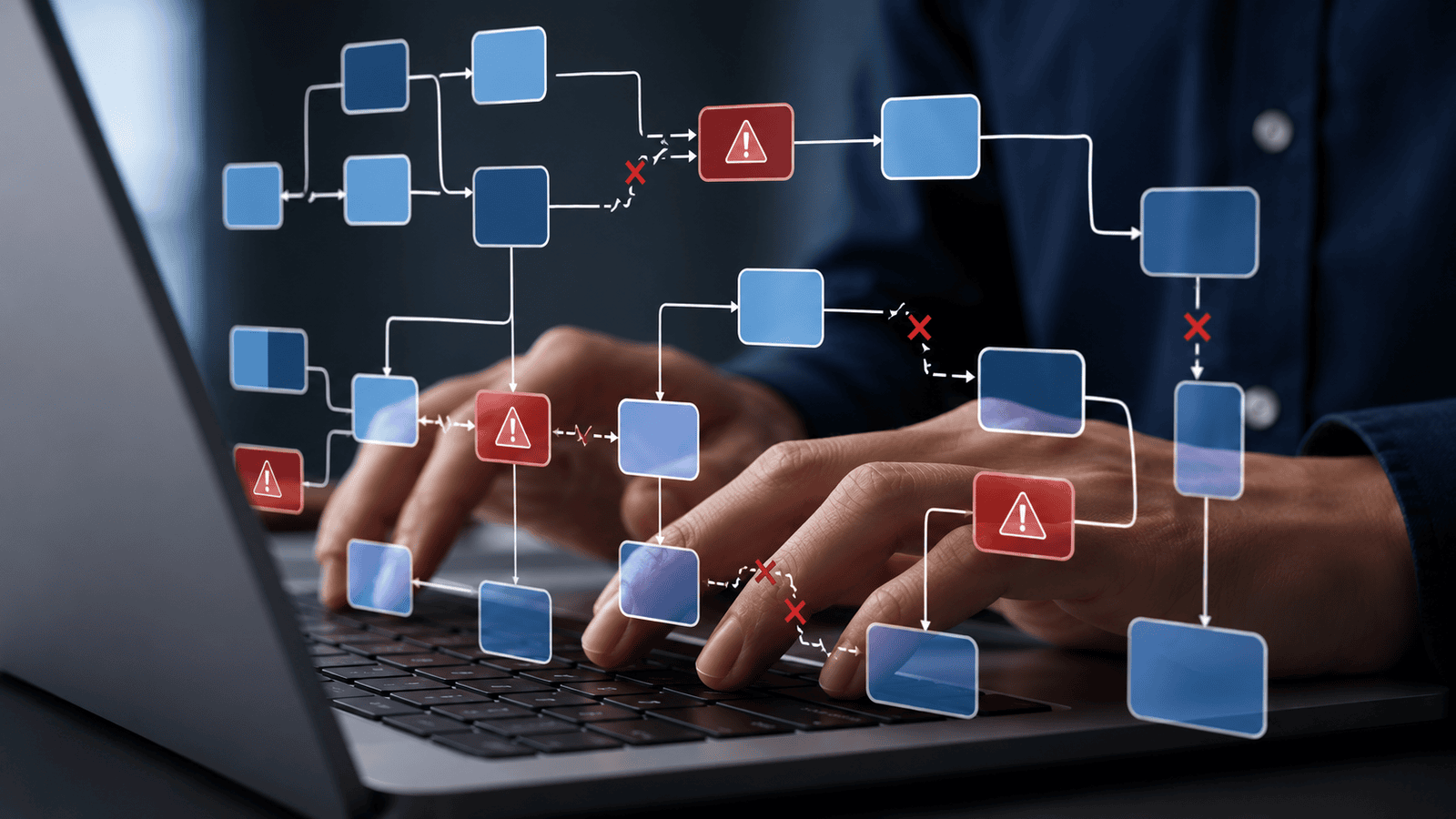
Here's the mistake many business owners make: they either avoid AI entirely out of fear, or they adopt it without a plan and expect it to fix disorganized processes on its own.
AI amplifies whatever system it's plugged into. If your invoicing process is a mess, automating it just makes the mess move faster. If your customer follow-up process is inconsistent, AI will follow that inconsistency at scale.
Common mistakes to avoid:
- Automating a broken process instead of fixing it first
- Over-relying on AI for tasks that require human judgment, like financial decisions or client negotiations
- Skipping oversight. AI output should always be reviewed, not blindly trusted
- Trying to automate everything at once instead of starting with one high-friction task
Industry data supports a cautious, step-by-step approach. Most business owners aren't fully confident handing over tasks without supervision, and that instinct is a healthy one. AI works best as a tool that supports human oversight, not a replacement for it.
How to Start Using AI Without Losing Control
You don't need to overhaul your entire business to benefit from automation. The most successful small businesses tend to follow a simple pattern:
- Identify one repetitive task that consumes real time each week (invoicing, scheduling, or customer follow-ups are common starting points)
- Automate that single workflow before adding more
- Review the results regularly rather than setting it and forgetting it
- Keep human judgment in the loop for anything involving money, compliance, or client relationships
- Scale gradually as you see measurable time or cost savings
This mirrors what's happening across the wider small business landscape in 2026, where the fastest-growing AI adoption is happening in customer support, marketing operations, sales administration, and finance, all areas packed with repetitive, high-volume work.
Best Practices for Sustainable Growth
Final Thoughts
AI isn't here to replace the entrepreneur behind the business. It's here to clear out the repetitive, low-value tasks that were never the reason you started the business in the first place. The owners seeing the biggest benefit aren't the ones handing over control, they're the ones using AI to protect their time so they can focus on the decisions only they can make.
The businesses that will struggle aren't the ones using AI. They're the ones automating disorganized systems without a clear plan, or avoiding the shift altogether while competitors get hours of their week back.
If you're building or growing a business right now, the smartest move isn't choosing between AI and human judgment, it's building systems where both work together. Getting your processes, records, and workflows properly organized first makes any automation you add afterward far more effective. If you're not sure where to start, speaking with a professional who understands both your industry and modern business systems can help you build a foundation that scales.
Artificial Intelligence Statistics for Small Business (Updated for 2026) - ColorWhistle
2026 Small Business AI Trends Report - Bluevine
Artificial Intelligence Statistics for Small Business 2026 - Krishang Technolab
7 Best AI Automation for Small Business Tools in 2026 - The Crunch
Small Business AI Automation Trends 2026 Investments - Ascendure Pro
AI Automation for Small Business Statistics You Need to Know in 2026 - Deantek